Continued from
Part I - Stay at Kyoto
Part II - Fushimi Inari Taisha
For this trip to Kansai, I had planned for Plum (Ume) Blossom viewing because I roughly know that it's during the February period, but we might be a tad too early as plum blossoms typically bloom from mid Feb onwards till Mar, before the Cherry Blossom.
Luckily I came across an article about Ume Blossom at Kitano Tenmangu Shrine in Kyoto and their FB page announced that some of the ume blossoms had started to bloom and others budding.
Kitano Tenmangu Shrine is built over 1000 years ago, in honour of Sugawara no Michizane, a scholar and politician who is known as "god of agriculture", "god of honesty and sincerity", "god of
dispelling false accusations", "god of performing arts" and most importantly, "god of academics". Many students would visit the shrine during the examination period to pray for good passing scores and improvement of their abilities.
Kitano Tenmangu features a grove of almost 2000 ume trees
inside the Bai-en (ume garden) which is open to the public for a fee of
700 yen.
When we reached the shrine, we decided to walk
around the grounds first (free) before entering the Bai-en. As we strolled, we
realised that there are plenty of ume trees scattered around the shrine and enough to satisfy our viewing actually. So we found that it's not necessary to pay the additional entrance fee to enter the Bai-en.
The plum blossoms were so pretty, comparable to cherry blossoms if not prettier. It's so understated! I mean, why is everyone focusing only on cherry blossom? Perhaps the cherry blossom has always been widely publicised with more commercial connotations. Anyways, I love them both. How I envy people staying in temperate countries like Japan and Korea where flowers bloom and trees change colour according to seasons.
We spent a couple of hours at the shrine, admiring the beauty of the ume. Understand that the shrine also hosts a special tea ceremony called the Baikasai in the Bai-en every 25th Feb, attended by maiko and geiko from the nearby Kamishichiken geiko district.
And on the 25th of each month, a flea market is held at the shrine and surrounding streets with hundreds of vendors selling antiques, crafts, art, plants, toys, as well as food stands selling street food like takoyaki, yakisoba and more.
Too bad we missed these festivities. Next time, hopefully.
Stay tuned for upcoming Part IV - Nishiki Ichiba Kyoto, Kuromon Ichiba Osaka
Showing posts with label Vacation - Japan Kansai. Show all posts
04 February 2017
03 February 2017
Kansai Feb 2016 Highlights Part II - Fushimi Inari Taisha
Continued from
Part I - Stay at Kyoto
Fushimi Inari Taisha (伏見稲荷大社) is a must-visit place for me this trip. Previously we had always went to Kiyomizudera, Kinkakuji, Ginkakuji, but missed out on Fushimi Inari, or rather I didn't know about it until the recent years.
I learnt that Fushimi Inari is an important Shinto Shrine in southern Kyoto, famous for its thousands of torii gates, leading into the forest of Mount Inari.
The shrine is dedicated to Inari, the Shinto god of rice and as foxes are thought to be Inari's messengers, there are many fox statues around the grounds of the shrine.
The day we went to Fushimi Inari was 3 Feb, which happened to be Setsubun (節分) meaning "Seasonal Division", signifying the beginning of spring. At Buddhist temples and Shinto shrines, there will be a special ritual called mamemaki (豆撒き) by the Priests and invited guests where they would scatter roasted soybeans called "fortune beans" (福豆 fuku mame). This is said to cleanse all the evil of the former year and drive away disease-bringing evil spirits for the coming year.
So we witnessed the ceremony and people were all trying to catch one of these little bags of fortune beans :)
These lovely ladies in Kimonos were the invited guests to help scatter the fortune beans.
The Priests who were administering the ritual.
Map of Fushimi Inari. It would probably take an hour or two to climb all the way to the summit.
The torii gates are located behind the main grounds of the shrine. It was really crowded with narrow paths and impossible to take any photos without the large crowd photobombing.
But we walked further and further, the paths became more spacious and the crowd dispersed considerably.
The right side of the torii gates indicate the year and month the gate was constructed.
Here's the donation chart if any company or individuals wish to erect a torii gate for blessings.
It felt serene to walk through rows and rows of the vermilion torii gates, where there was no crowd and the air was cold and crisp.
Names of the company or individuals who made the donations were imprinted on the left side of the gate.
Ema 絵馬 (えま)
It's common to see this in Shinto Shrines, where temple goers could write wishes on a piece of wood and hang it up for blessings and pray that the wishes would come true.
As we walked further uphill, could see that the torii gates looked older and more spaced out.
Finally we arrived at an area where we could enjoy some udon and inari sushi, but the eateries were all closed :( Not sure if it was because of the Setsubun or they only open during weekends?
The kiddo was complaining of hunger and we were pushing him to keep climbing for the udon. Oh well.
Decided to turn back downhill via another route and to our delight, we found an eatery on the way down :)
Yay, and we enjoyed our well-deserved inari udon and oden udon after one and a half hours of uphill hiking.
The best was yet to come because upon exiting the shrine, we saw an open-air food street to the right of the shrine, along with some shops. Yay, time for more food and shopping! Not sure if the food vendors were permanent or only during festive seasons?
Cold weather called for meat! This yakitori with a sticky sweet teriyaki sauce was sooooo yummy!
Takoyaki, also perfect for the cold weather!
Tempted to try the Okonomiyaki but the portion was too big.
Grilled beef! Unfortunately the cut was of lower quality and the meat too tough.
OMG! This grilled bacon with mayonnaise was da bomb! The pork was salty and greasy, smelled and tasted so good!
This grilled sweet potato coated with sugar was super yummy as well, and we just had to get seconds.
Overall, the Fushimi Inari Taisha was a lovely shrine to spend the morning, be sure to walk further uphill to get away from the crowd and truly enjoy the peacefulness of the mountain. Thereafter, it's befitting to enjoy a nice hot bowl of inari udon or some street food to complete the experience.
Stay tuned for Part III - Plum Blossom viewing at Tenmangu Shrine.
Part I - Stay at Kyoto
Fushimi Inari Taisha (伏見稲荷大社) is a must-visit place for me this trip. Previously we had always went to Kiyomizudera, Kinkakuji, Ginkakuji, but missed out on Fushimi Inari, or rather I didn't know about it until the recent years.
I learnt that Fushimi Inari is an important Shinto Shrine in southern Kyoto, famous for its thousands of torii gates, leading into the forest of Mount Inari.
The shrine is dedicated to Inari, the Shinto god of rice and as foxes are thought to be Inari's messengers, there are many fox statues around the grounds of the shrine.
So we witnessed the ceremony and people were all trying to catch one of these little bags of fortune beans :)
These lovely ladies in Kimonos were the invited guests to help scatter the fortune beans.
The Priests who were administering the ritual.
Map of Fushimi Inari. It would probably take an hour or two to climb all the way to the summit.
The torii gates are located behind the main grounds of the shrine. It was really crowded with narrow paths and impossible to take any photos without the large crowd photobombing.
But we walked further and further, the paths became more spacious and the crowd dispersed considerably.
The right side of the torii gates indicate the year and month the gate was constructed.
Here's the donation chart if any company or individuals wish to erect a torii gate for blessings.
It felt serene to walk through rows and rows of the vermilion torii gates, where there was no crowd and the air was cold and crisp.
Names of the company or individuals who made the donations were imprinted on the left side of the gate.
Ema 絵馬 (えま)
It's common to see this in Shinto Shrines, where temple goers could write wishes on a piece of wood and hang it up for blessings and pray that the wishes would come true.
As we walked further uphill, could see that the torii gates looked older and more spaced out.
Finally we arrived at an area where we could enjoy some udon and inari sushi, but the eateries were all closed :( Not sure if it was because of the Setsubun or they only open during weekends?
The kiddo was complaining of hunger and we were pushing him to keep climbing for the udon. Oh well.
Decided to turn back downhill via another route and to our delight, we found an eatery on the way down :)
Yay, and we enjoyed our well-deserved inari udon and oden udon after one and a half hours of uphill hiking.
The best was yet to come because upon exiting the shrine, we saw an open-air food street to the right of the shrine, along with some shops. Yay, time for more food and shopping! Not sure if the food vendors were permanent or only during festive seasons?
Cold weather called for meat! This yakitori with a sticky sweet teriyaki sauce was sooooo yummy!
Takoyaki, also perfect for the cold weather!
Tempted to try the Okonomiyaki but the portion was too big.
Grilled beef! Unfortunately the cut was of lower quality and the meat too tough.
OMG! This grilled bacon with mayonnaise was da bomb! The pork was salty and greasy, smelled and tasted so good!
This grilled sweet potato coated with sugar was super yummy as well, and we just had to get seconds.
Overall, the Fushimi Inari Taisha was a lovely shrine to spend the morning, be sure to walk further uphill to get away from the crowd and truly enjoy the peacefulness of the mountain. Thereafter, it's befitting to enjoy a nice hot bowl of inari udon or some street food to complete the experience.
Stay tuned for Part III - Plum Blossom viewing at Tenmangu Shrine.
Kansai Feb 2016 Highlights Part I - Stay at Kyoto
Oh couldn't believe that it has been one year since my last trip to Japan!
Last year during this time, my family (MIL, Mom, HB, Kiddo and I) escaped "避年" to Kansai for the Lunar New Year; and I have procrastinated in writing my travel journal for one whole year -_-
All of us (except for the kiddo) have been to Kansai a few times, but somehow apart from my detailed journal back in Dec 2007, I realised I didn't blog about my subsequent trips (cannot remember one or two) to Kansai at all.
Anyways, although I'm one year late, better than never :p Decided to just highlight a few memorable places and places I've not been to previously with mostly photos :p
Part I - Stay at Kyoto
Part II - Fushimi Inari Taisha, Kyoto
Part III - Kitano Tenmangu, Kyoto
Part IV - Nishiki Ichiba Kyoto, Kuromon Ichiba Osaka
Part V - Universal Studios Japan Osaka, Expocity Osaka
Part VI - Food
Since we have elderly and a young kiddo and had been to many must-see attractions already, the itinerary planned was very relaxed, basically to enjoy the cold weather and food!
Day 1 - Arrival KIX, transfer via limited express train to Kyoto
Day 2 - Fushimi Inari Taisha (伏見稲荷大社), JR Kyoto Station
Day 3 - Kitano Tenmangu (北野天満宮), Nishiki Ichiba (錦市場)
Day 4 - Transfer from Kyoto to Osaka (Namba), Dontonbori (道頓堀), Sennichimae Doguyasuji (千日前道具屋筋商店街)
Day 5 - Meet my host family (homestay programme back in 2003), Suita Expocity, Shinsaibashi
Day 6 - Universal Studios Japan
Day 7,8 - Shopping at Shinsaibashi, Tokyuhands, Tomizawa Baking Supply (Takashimaya, Namba City), JHC Baking Supply (near Namba City), Kuromon Ichiba, Donki
As we took a daytime flight, by the time we reached Kansai International Airport and transferred to Kyoto via train, it was close to midnight. Hence after an extensive research and consideration about timing and all, decided to stay at Kyoto Hot Spring Hatoya Zuihokaku Hotel which is a 8-10 min walk from Kyoto JR station.
Initially I wanted to stay at a traditional ryokan with hot spring but most ryokans are located some distance away from Kyoto station. Had to forgo the idea as it was going to be cold and everyone would be tired by the long travelling already, and it would be difficult to get cab for 5 of us.
Kyoto Hot Spring Hatoya Zuihokaku Hotel sort of met with all my expectations. It was within walking distance from Kyoto station, it has traditional tatami rooms and it even has a natural hot spring where water for the baths is drawn up from the underground of the hotel. In fact, it is supposedly the only hotel near Kyoto station with natural hot spring water.
So I guess this was the best option I had. Didn't want to change hotel (to a ryokan) either because we were only staying for 3 nights and it would be inconvenient logistically for all of us.
Staff at the hotel were gracious and friendly and spoke a little English, so basic communication wasn't an issue.
Lounge area at the hotel lobby.
Booked 2 tatami rooms for us. Preferred tatami rooms because it's more spacious after beddings are put away. And I wanted the kiddo to experience a tatami room :)
The room was well-maintained and speckless, true to Japanese standards.
Bathroom was spacious spotless as well.
Was surprised by the size of the bathtub because usually the baths in Japanese hotels are small and squarish in size.
The highlight of this hotel is the hot spring, and I must say the hot spring was indeed popular during the period we stayed. There were always people in the onsen that I couldn't take any photos at all. (unlike the ryokans I stayed at the outskirt areas where usually I was the only person or only a couple of people who would leave shortly).
Anyways, I waited till the morning before checking out and when the staff were starting to wash the baths to quickly snap some photos.
The male and female baths are switched every day after the washing.
Female bath.
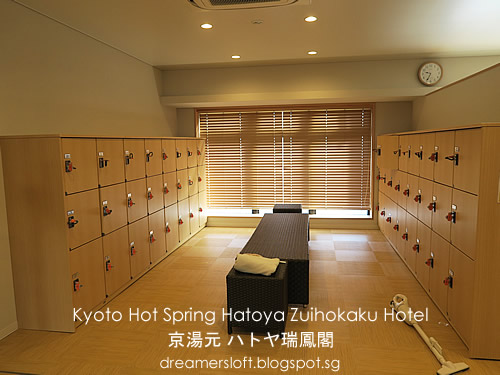
Locker area.
Bath area.
Indoor onsen.
Outdoor onsen.
Male bath.
Washing area.
Indoor onsen.
Outdoor onsen.
Lounge area outside the baths where guests could enjoy natural spring water free of charge.
Overall the stay at this hotel was enjoyable and highly recommended for anyone who wish to stay near Kyoto Station and yet enjoy tatami rooms with natural onsen.
Next up, part II - Fushimi Inari Taisha
Last year during this time, my family (MIL, Mom, HB, Kiddo and I) escaped "避年" to Kansai for the Lunar New Year; and I have procrastinated in writing my travel journal for one whole year -_-
All of us (except for the kiddo) have been to Kansai a few times, but somehow apart from my detailed journal back in Dec 2007, I realised I didn't blog about my subsequent trips (cannot remember one or two) to Kansai at all.
Anyways, although I'm one year late, better than never :p Decided to just highlight a few memorable places and places I've not been to previously with mostly photos :p
Part I - Stay at Kyoto
Part II - Fushimi Inari Taisha, Kyoto
Part III - Kitano Tenmangu, Kyoto
Part IV - Nishiki Ichiba Kyoto, Kuromon Ichiba Osaka
Part V - Universal Studios Japan Osaka, Expocity Osaka
Part VI - Food
Since we have elderly and a young kiddo and had been to many must-see attractions already, the itinerary planned was very relaxed, basically to enjoy the cold weather and food!
Day 1 - Arrival KIX, transfer via limited express train to Kyoto
Day 2 - Fushimi Inari Taisha (伏見稲荷大社), JR Kyoto Station
Day 3 - Kitano Tenmangu (北野天満宮), Nishiki Ichiba (錦市場)
Day 4 - Transfer from Kyoto to Osaka (Namba), Dontonbori (道頓堀), Sennichimae Doguyasuji (千日前道具屋筋商店街)
Day 5 - Meet my host family (homestay programme back in 2003), Suita Expocity, Shinsaibashi
Day 6 - Universal Studios Japan
Day 7,8 - Shopping at Shinsaibashi, Tokyuhands, Tomizawa Baking Supply (Takashimaya, Namba City), JHC Baking Supply (near Namba City), Kuromon Ichiba, Donki
As we took a daytime flight, by the time we reached Kansai International Airport and transferred to Kyoto via train, it was close to midnight. Hence after an extensive research and consideration about timing and all, decided to stay at Kyoto Hot Spring Hatoya Zuihokaku Hotel which is a 8-10 min walk from Kyoto JR station.
Initially I wanted to stay at a traditional ryokan with hot spring but most ryokans are located some distance away from Kyoto station. Had to forgo the idea as it was going to be cold and everyone would be tired by the long travelling already, and it would be difficult to get cab for 5 of us.
Kyoto Hot Spring Hatoya Zuihokaku Hotel sort of met with all my expectations. It was within walking distance from Kyoto station, it has traditional tatami rooms and it even has a natural hot spring where water for the baths is drawn up from the underground of the hotel. In fact, it is supposedly the only hotel near Kyoto station with natural hot spring water.
So I guess this was the best option I had. Didn't want to change hotel (to a ryokan) either because we were only staying for 3 nights and it would be inconvenient logistically for all of us.
Staff at the hotel were gracious and friendly and spoke a little English, so basic communication wasn't an issue.
Lounge area at the hotel lobby.
Restaurant at lobby area where breakfast is served, we didn't have opportunity to dine there though.
Booked 2 tatami rooms for us. Preferred tatami rooms because it's more spacious after beddings are put away. And I wanted the kiddo to experience a tatami room :)
The room was well-maintained and speckless, true to Japanese standards.
Bathroom was spacious spotless as well.
Was surprised by the size of the bathtub because usually the baths in Japanese hotels are small and squarish in size.
The highlight of this hotel is the hot spring, and I must say the hot spring was indeed popular during the period we stayed. There were always people in the onsen that I couldn't take any photos at all. (unlike the ryokans I stayed at the outskirt areas where usually I was the only person or only a couple of people who would leave shortly).
Anyways, I waited till the morning before checking out and when the staff were starting to wash the baths to quickly snap some photos.
The male and female baths are switched every day after the washing.
Female bath.
Locker area.
Bath area.
Indoor onsen.
Outdoor onsen.
Male bath.
Washing area.
Indoor onsen.
Outdoor onsen.
Lounge area outside the baths where guests could enjoy natural spring water free of charge.
Overall the stay at this hotel was enjoyable and highly recommended for anyone who wish to stay near Kyoto Station and yet enjoy tatami rooms with natural onsen.
Next up, part II - Fushimi Inari Taisha
Subscribe to:
Posts (Atom)